> ## Documentation Index
> Fetch the complete documentation index at: https://docs.wandb.ai/llms.txt
> Use this file to discover all available pages before exploring further.
# Cohere
> Weave を使用して、Cohere Python ライブラリ経由で行われる LLM call を自動的にトラッキングしてログする
 `weave.init()` を呼び出した後、Weave は [Cohere Python ライブラリ](https://github.com/cohere-ai/cohere-python) 経由で行われる LLM call を自動的にトラッキングしてログします。
## トレース
開発中でも本番環境でも、LLM アプリケーションのトレースを一元管理されたデータベースに保存することが重要です。これらのトレースは、デバッグや、アプリケーション改善に役立つデータセットとして活用できます。
Weave は `cohere-python` のトレースを自動的に取得します。ライブラリは通常どおり使用でき、まず `weave.init()` を呼び出します:
```python lines {8} theme={null}
import cohere
import os
import weave
# Cohere ライブラリを通常どおり使用する
co = cohere.Client(api_key=os.environ["COHERE_API_KEY"])
weave.init("cohere_project")
response = co.chat(
message="How is the weather in Boston?",
# 質問に回答する前にウェブ検索を実行します。独自の custom コネクタを使用することもできます。
connectors=[{"id": "web-search"}],
)
print(response.text)
```
`weave.init()` の呼び出し時に W\&B team を指定しない場合、Weave はデフォルトの entity を使用します。デフォルトの entity を確認または更新するには、W\&B Models ドキュメントの [User Settings](https://docs.wandb.ai/platform/app/settings-page/user-settings/#default-team) を参照してください。
Cohere モデルは [connectors](https://docs.cohere.com/docs/overview-rag-connectors#using-connectors-to-create-grounded-generations) をサポートしており、これを使用するとエンドポイント側から他の API へリクエストを送信できます。レスポンスには、コネクタ から返されたドキュメントへのリンクを含む citation 要素付きの生成テキストが含まれます。
[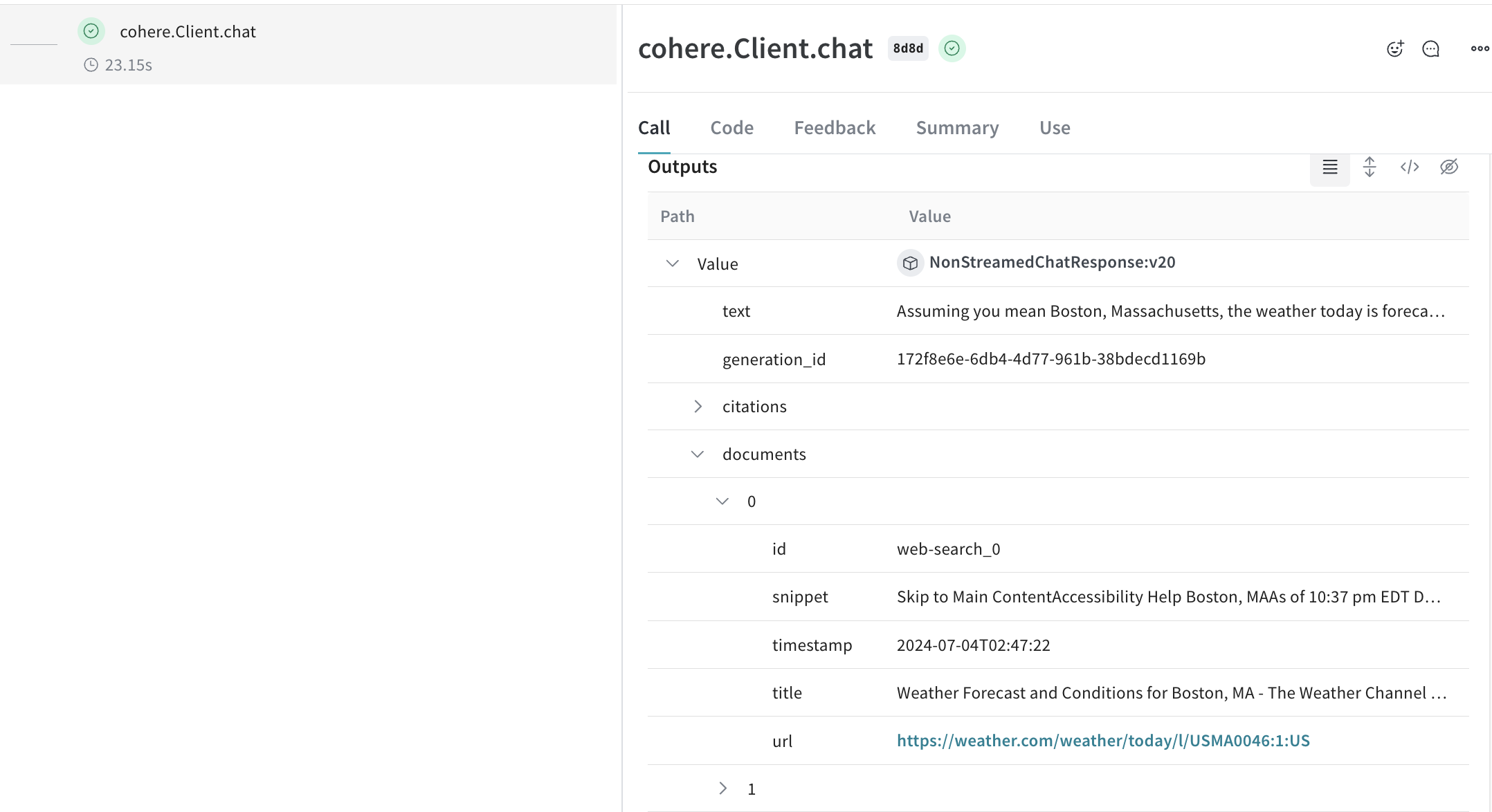 ](https://wandb.ai/capecape/cohere_dev/weave/calls)
LLM Call をトラッキングするために、Weave は Cohere の `Client.chat()`、`AsyncClient.chat()`、`Client.chat_stream()`、`AsyncClient.chat_stream()` の各 method にパッチを適用します。
](https://wandb.ai/capecape/cohere_dev/weave/calls)
LLM Call をトラッキングするために、Weave は Cohere の `Client.chat()`、`AsyncClient.chat()`、`Client.chat_stream()`、`AsyncClient.chat_stream()` の各 method にパッチを適用します。
## 独自の op でラップする
Weave の op を使うと、実験を進めながらコードが自動的にバージョン管理され、入力と出力も記録されるため、結果を\_再現可能\_にできます。Cohere の chat method を呼び出す [`@weave.op()`](/ja/weave/guides/tracking/ops) でデコレートした関数を作成すると、Weave が入力と出力をトラッキングしてくれます。以下はその例です。
```python lines {9} theme={null}
import cohere
import os
import weave
co = cohere.Client(api_key=os.environ["COHERE_API_KEY"])
weave.init("cohere_project")
@weave.op()
def weather(location: str, model: str) -> str:
response = co.chat(
model=model,
message=f"How is the weather in {location}?",
# 質問に回答する前にウェブ検索を実行します。独自のカスタムコネクタを使用することもできます。
connectors=[{"id": "web-search"}],
)
return response.text
print(weather("Boston", "command"))
```
[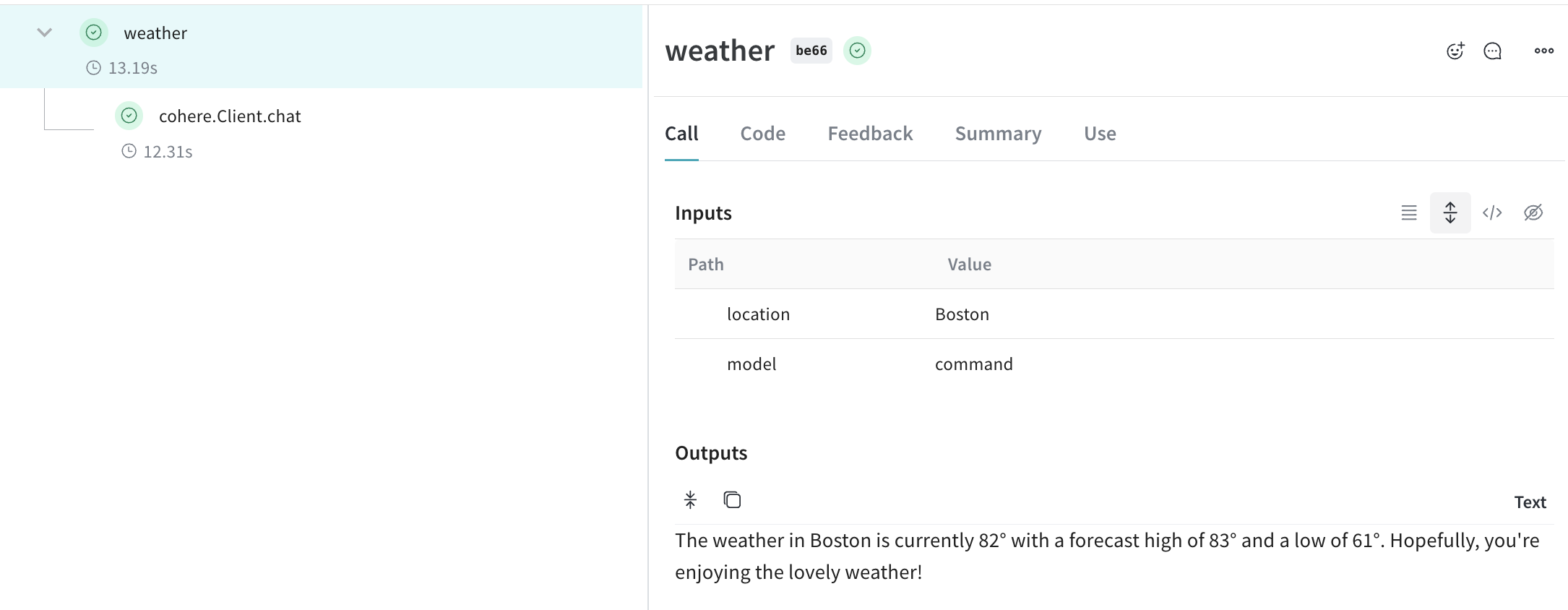 ](https://wandb.ai/capecape/cohere_dev/weave/calls)
## 実験をしやすくするために `Model` を作成する
複数の要素が絡む実験では、情報を整理するのが難しくなります。[`Model`](/ja/weave/guides/core-types/models) クラスを使用すると、system prompt や使用しているモデルなど、アプリの実験に関する詳細を記録して整理できます。これにより、アプリのさまざまなバージョンを整理し、比較しやすくなります。
[`Model`](/ja/weave/guides/core-types/models) は、コードのバージョン管理や入力/出力の記録に加えて、アプリケーションの挙動を制御する構造化されたパラメーターも保持するため、どのパラメーターが最も効果的だったかを見つけやすくなります。また、Weave Models は `serve` や [`Evaluation`](/ja/weave/guides/core-types/evaluations) でも使用できます。
以下の例では、`model` と `temperature` を試せます。これらのいずれかを変更するたびに、`WeatherModel` の新しい *version* が作成されます。
```python lines theme={null}
import weave
import cohere
import os
weave.init('weather-cohere')
class WeatherModel(weave.Model):
model: str
temperature: float
@weave.op()
def predict(self, location: str) -> str:
co = cohere.Client(api_key=os.environ["COHERE_API_KEY"])
response = co.chat(
message=f"How is the weather in {location}?",
model=self.model,
temperature=self.temperature,
connectors=[{"id": "web-search"}]
)
return response.text
weather_model = WeatherModel(
model="command",
temperature=0.7
)
result = weather_model.predict("Boston")
print(result)
```
[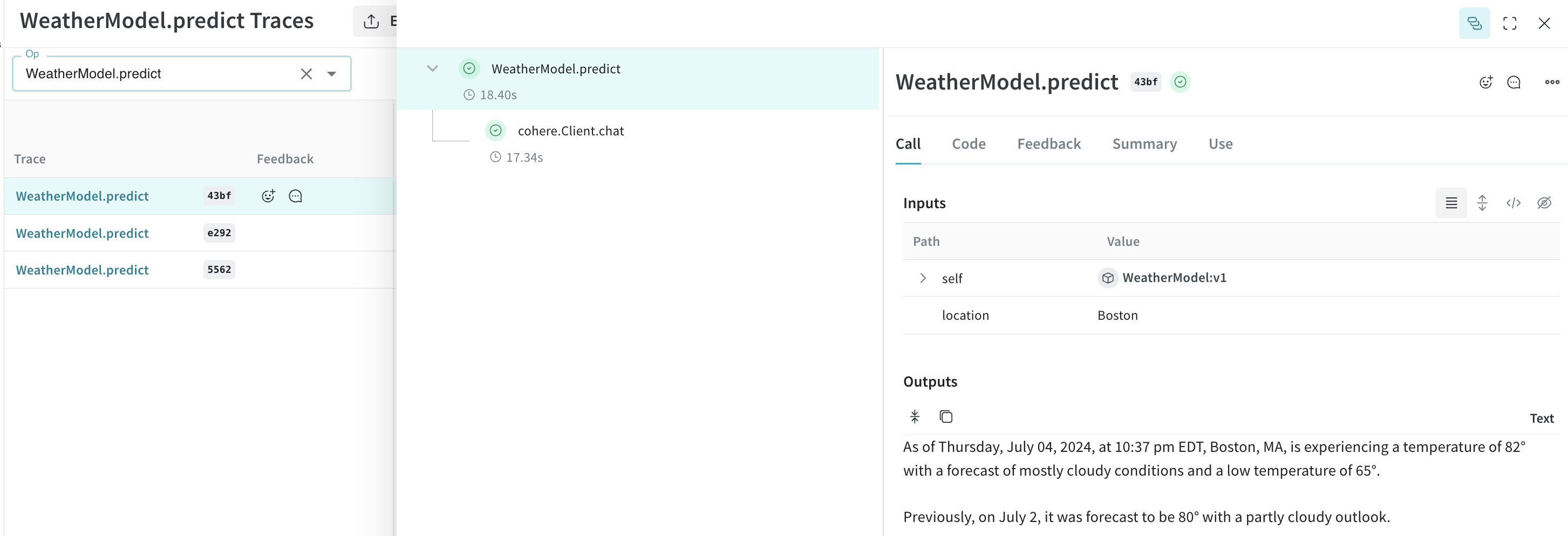 ](https://wandb.ai/capecape/cohere_dev/weave/models)