> ## Documentation Index
> Fetch the complete documentation index at: https://docs.wandb.ai/llms.txt
> Use this file to discover all available pages before exploring further.
# LiteLLM
> LiteLLM을 통한 LLM Call을 자동으로 추적하고 로깅합니다
 `weave.init()`을 호출하면 Weave가 LiteLLM을 통한 LLM Call을 자동으로 추적하고 로깅합니다. 이 가이드에서는 Weave와 LiteLLM을 함께 사용해 트레이스를 캡처하고, Call을 버전 관리되는 ops로 래핑하고, `Model`로 Experiments를 구성하고, 함수 호출 동작을 추적하는 방법을 설명합니다. LiteLLM이 지원하는 여러 모델 공급자 전반에서 관측성이 필요할 때 LLM 애플리케이션을 구축하는 경우 이 가이드를 사용하세요.
## 트레이스
개발 중이든 프로덕션 환경이든, LLM 애플리케이션의 트레이스를 중앙 데이터베이스에 저장하는 것은 중요합니다. 이러한 트레이스는 디버깅에 활용하고, 애플리케이션 개선에 도움이 되는 데이터셋으로도 사용할 수 있습니다.
> **참고:** LiteLLM을 사용할 때는 `from litellm import completion` 대신 `import litellm`으로 라이브러리를 임포트하고, completion 함수는 `litellm.completion()`으로 호출해야 합니다. 이렇게 해야 모든 함수와 파라미터가 올바르게 참조됩니다.
Weave는 LiteLLM의 트레이스를 자동으로 캡처합니다. 라이브러리는 평소처럼 사용하고, 먼저 `weave.init()`를 호출해 시작하세요:
```python lines {4} theme={null}
import litellm
import weave
weave.init("weave_litellm_integration")
openai_response = litellm.completion(
model="gpt-3.5-turbo",
messages=[{"role": "user", "content": "Translate 'Hello, how are you?' to French"}],
max_tokens=1024
)
print(openai_response.choices[0].message.content)
claude_response = litellm.completion(
model="claude-3-5-sonnet-20240620",
messages=[{"role": "user", "content": "Translate 'Hello, how are you?' to French"}],
max_tokens=1024
)
print(claude_response.choices[0].message.content)
```
이제 Weave는 LiteLLM을 통해 발생하는 모든 LLM Call을 추적하고 로깅합니다. Weave 웹 인터페이스에서 트레이스를 확인할 수 있습니다. 기본 트레이싱이 마련되었으므로, 다음 섹션에서는 LiteLLM Call을 자체 Weave ops로 감싸 애플리케이션 로직을 더 세밀하게 추적하고 버전별로 관리하는 방법을 보여줍니다.
## 자체 ops로 감싸기
Weave ops는 실험하는 동안 코드 버전을 자동으로 관리하고 입력과 출력을 캡처해 결과를 재현 가능하게 만듭니다. `@weave.op()`으로 데코레이팅한 함수를 만들고 그 안에서 LiteLLM의 completion 함수를 호출하면, Weave가 입력과 출력을 추적해 줍니다. 다음은 예시입니다:
```python lines {4,6} theme={null}
import litellm
import weave
weave.init("weave_litellm_integration")
@weave.op()
def translate(text: str, target_language: str, model: str) -> str:
response = litellm.completion(
model=model,
messages=[{"role": "user", "content": f"Translate '{text}' to {target_language}"}],
max_tokens=1024
)
return response.choices[0].message.content
print(translate("Hello, how are you?", "French", "gpt-3.5-turbo"))
print(translate("Hello, how are you?", "Spanish", "claude-3-5-sonnet-20240620"))
```
## 더 쉽게 실험할 수 있도록 `Model` 만들기
많은 요소가 동시에 움직이면 실험을 체계적으로 정리하기가 어렵습니다. `Model` 클래스를 사용하면 시스템 프롬프트나 사용 중인 모델처럼 앱의 실험 관련 세부 정보를 캡처하고 정리할 수 있습니다. 이렇게 하면 앱의 여러 반복 버전을 정리하고 비교하는 데 도움이 됩니다.
Models는 코드 버전 관리와 입력 및 출력 캡처에 더해, 애플리케이션 동작을 제어하는 구조화된 매개변수도 함께 캡처하므로 어떤 매개변수가 가장 효과적인지 찾는 데 도움이 됩니다. Weave Models는 `serve` 및 Evaluations와 함께 사용할 수도 있습니다.
다음 예시에서는 다양한 모델과 temperature로 실험할 수 있습니다:
```python lines {4,6,10} theme={null}
import litellm
import weave
weave.init('weave_litellm_integration')
class TranslatorModel(weave.Model):
model: str
temperature: float
@weave.op()
def predict(self, text: str, target_language: str):
response = litellm.completion(
model=self.model,
messages=[
{"role": "system", "content": f"You are a translator. Translate the given text to {target_language}."},
{"role": "user", "content": text}
],
max_tokens=1024,
temperature=self.temperature
)
return response.choices[0].message.content
# 다양한 모델로 인스턴스 생성
gpt_translator = TranslatorModel(model="gpt-3.5-turbo", temperature=0.3)
claude_translator = TranslatorModel(model="claude-3-5-sonnet-20240620", temperature=0.1)
# 번역에 다양한 모델 사용
english_text = "Hello, how are you today?"
print("GPT-3.5 Translation to French:")
print(gpt_translator.predict(english_text, "French"))
print("\nClaude-3.5 Sonnet Translation to Spanish:")
print(claude_translator.predict(english_text, "Spanish"))
```
## 함수 호출
LiteLLM은 호환되는 모델에서 함수 Call을 지원합니다. Weave는 이러한 함수 Call을 자동으로 추적하므로, 다른 트레이스와 함께 함수, 인수, 응답을 확인할 수 있습니다.
```python lines {4} theme={null}
import litellm
import weave
weave.init("weave_litellm_integration")
response = litellm.completion(
model="gpt-3.5-turbo",
messages=[{"role": "user", "content": "Translate 'Hello, how are you?' to French"}],
functions=[
{
"name": "translate",
"description": "Translate text to a specified language",
"parameters": {
"type": "object",
"properties": {
"text": {
"type": "string",
"description": "The text to translate",
},
"target_language": {
"type": "string",
"description": "The language to translate to",
}
},
"required": ["text", "target_language"],
},
},
],
)
print(response)
```
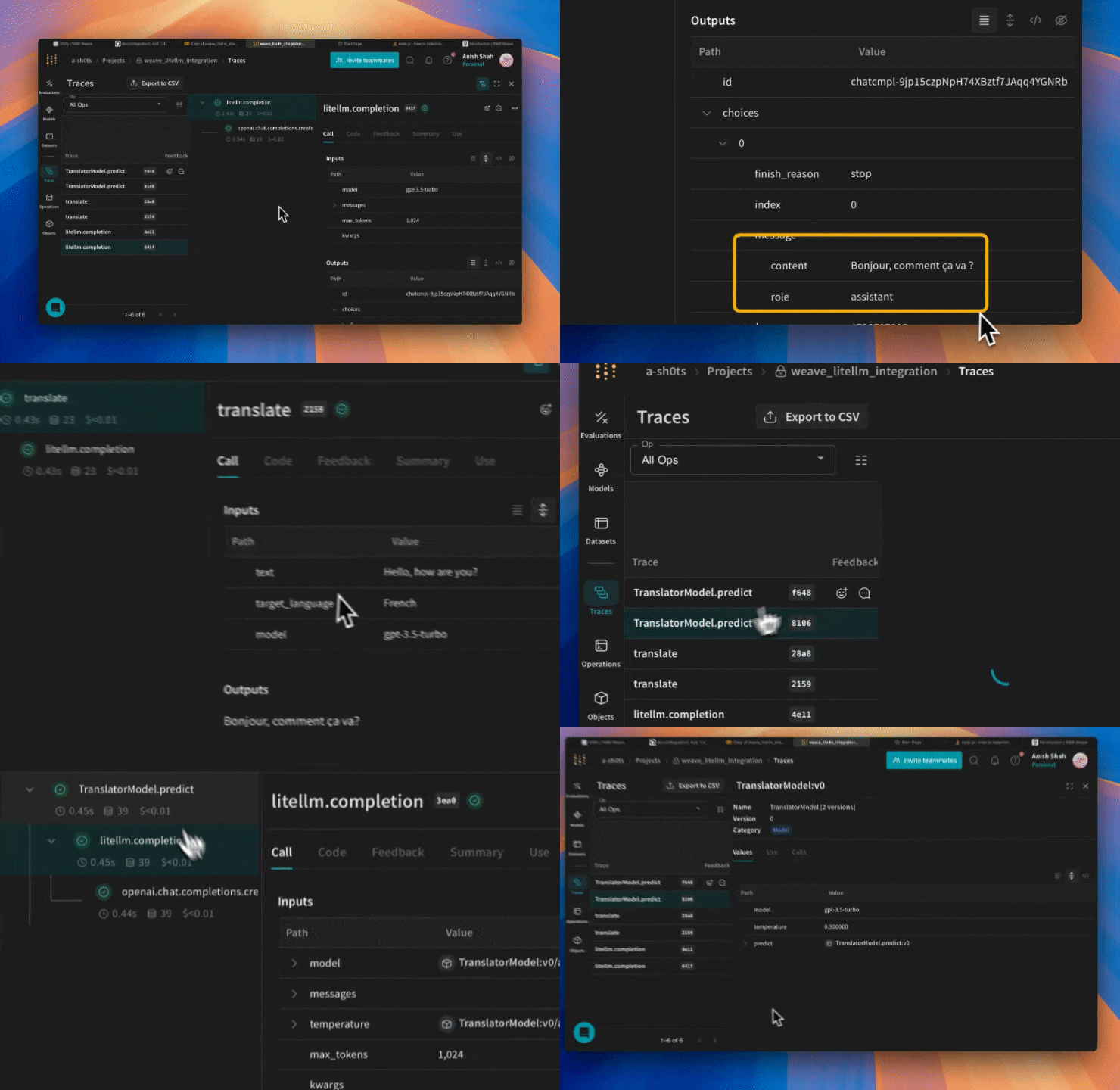
Weave는 프롬프트에서 사용한 함수를 자동으로 캡처하고 버전 관리합니다.
[ ](https://wandb.ai/a-sh0ts/weave_litellm_integration/weave/calls)