> ## Documentation Index
> Fetch the complete documentation index at: https://docs.wandb.ai/llms.txt
> Use this file to discover all available pages before exploring further.
> Integrate W&B with Stable Baselines3 to track reinforcement learning experiments and log training performance.
# Stable Baselines 3 PyTorch
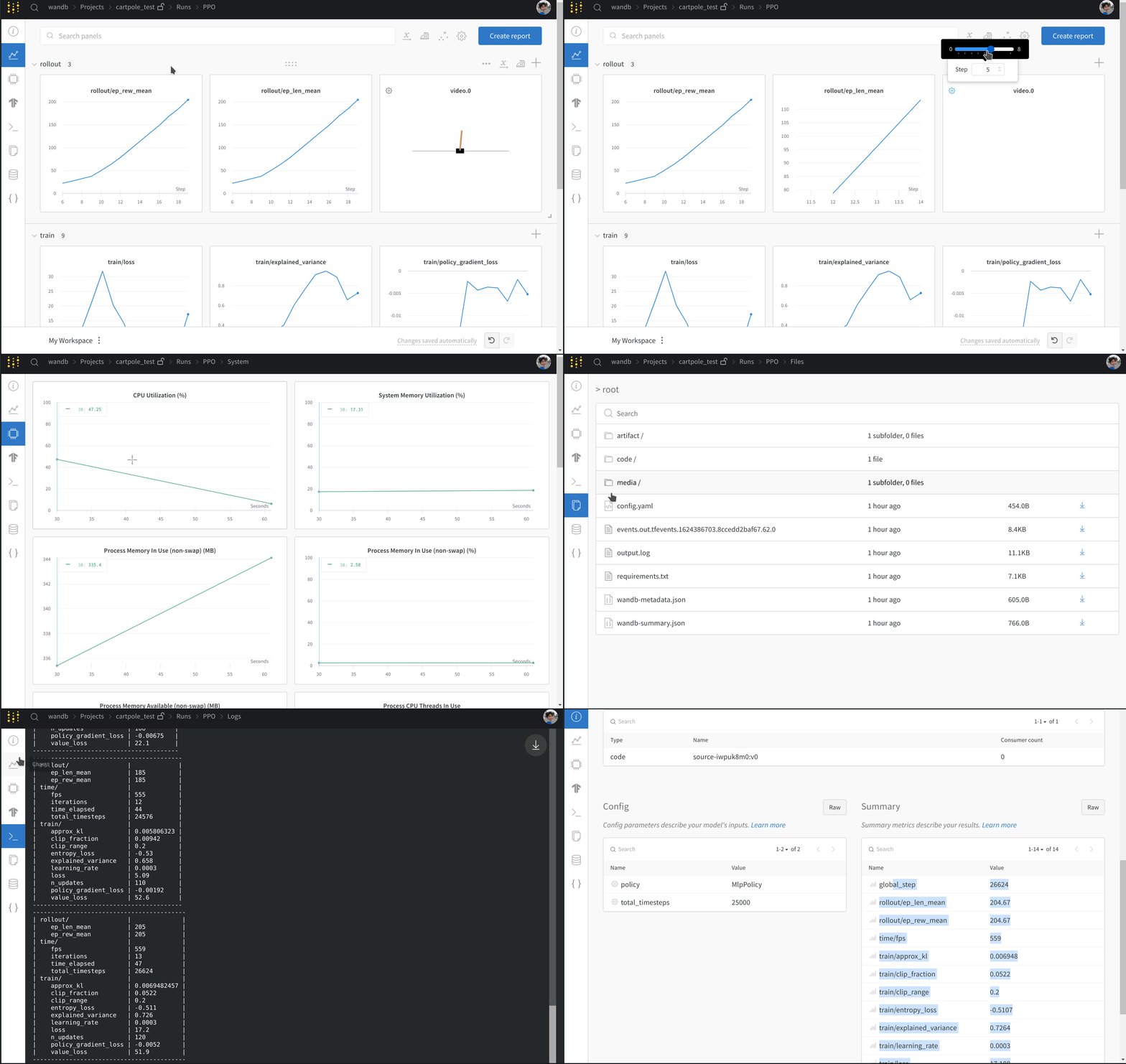
[Stable Baselines 3](https://github.com/DLR-RM/stable-baselines3) (SB3) is a set of reliable implementations of reinforcement learning algorithms in PyTorch. W\&B's SB3 integration:
* Records metrics such as losses and episodic returns.
* Uploads videos of agents playing the games.
* Saves the trained model.
* Logs the model's hyperparameters.
* Logs the model gradient histograms.
Review an [example SB3 training run](https://wandb.ai/wandb/sb3/runs/1jyr6z10).
## Log your SB3 experiments
```python theme={null}
from wandb.integration.sb3 import WandbCallback
model.learn(..., callback=WandbCallback())
```
 ## WandbCallback Arguments
| Argument | Usage |
| :------------------- | :--------------------------------------------------------------------------------------------------------- |
| `verbose` | The verbosity of sb3 output |
| `model_save_path` | Path to the folder where the model will be saved, The default value is \`None\` so the model is not logged |
| `model_save_freq` | Frequency to save the model |
| `gradient_save_freq` | Frequency to log gradient. The default value is 0 so the gradients are not logged |
## Basic example
The W\&B SB3 integration uses the logs output from TensorBoard to log your metrics
```python theme={null}
import gym
from stable_baselines3 import PPO
from stable_baselines3.common.monitor import Monitor
from stable_baselines3.common.vec_env import DummyVecEnv, VecVideoRecorder
import wandb
from wandb.integration.sb3 import WandbCallback
config = {
"policy_type": "MlpPolicy",
"total_timesteps": 25000,
"env_name": "CartPole-v1",
}
run = wandb.init(
project="sb3",
config=config,
sync_tensorboard=True, # auto-upload sb3's tensorboard metrics
monitor_gym=True, # auto-upload the videos of agents playing the game
save_code=True, # optional
)
def make_env():
env = gym.make(config["env_name"])
env = Monitor(env) # record stats such as returns
return env
env = DummyVecEnv([make_env])
env = VecVideoRecorder(
env,
f"videos/{run.id}",
record_video_trigger=lambda x: x % 2000 == 0,
video_length=200,
)
model = PPO(config["policy_type"], env, verbose=1, tensorboard_log=f"runs/{run.id}")
model.learn(
total_timesteps=config["total_timesteps"],
callback=WandbCallback(
gradient_save_freq=100,
model_save_path=f"models/{run.id}",
verbose=2,
),
)
run.finish()
```
## WandbCallback Arguments
| Argument | Usage |
| :------------------- | :--------------------------------------------------------------------------------------------------------- |
| `verbose` | The verbosity of sb3 output |
| `model_save_path` | Path to the folder where the model will be saved, The default value is \`None\` so the model is not logged |
| `model_save_freq` | Frequency to save the model |
| `gradient_save_freq` | Frequency to log gradient. The default value is 0 so the gradients are not logged |
## Basic example
The W\&B SB3 integration uses the logs output from TensorBoard to log your metrics
```python theme={null}
import gym
from stable_baselines3 import PPO
from stable_baselines3.common.monitor import Monitor
from stable_baselines3.common.vec_env import DummyVecEnv, VecVideoRecorder
import wandb
from wandb.integration.sb3 import WandbCallback
config = {
"policy_type": "MlpPolicy",
"total_timesteps": 25000,
"env_name": "CartPole-v1",
}
run = wandb.init(
project="sb3",
config=config,
sync_tensorboard=True, # auto-upload sb3's tensorboard metrics
monitor_gym=True, # auto-upload the videos of agents playing the game
save_code=True, # optional
)
def make_env():
env = gym.make(config["env_name"])
env = Monitor(env) # record stats such as returns
return env
env = DummyVecEnv([make_env])
env = VecVideoRecorder(
env,
f"videos/{run.id}",
record_video_trigger=lambda x: x % 2000 == 0,
video_length=200,
)
model = PPO(config["policy_type"], env, verbose=1, tensorboard_log=f"runs/{run.id}")
model.learn(
total_timesteps=config["total_timesteps"],
callback=WandbCallback(
gradient_save_freq=100,
model_save_path=f"models/{run.id}",
verbose=2,
),
)
run.finish()
```