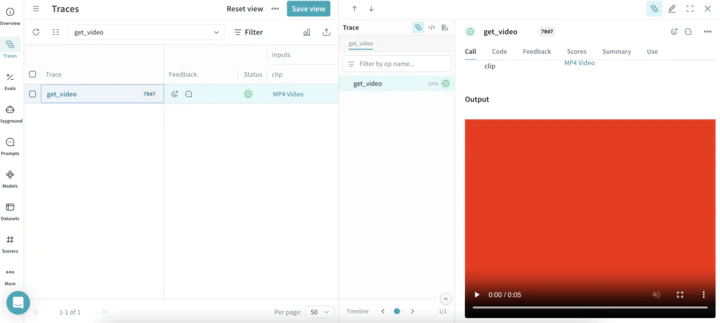
This guide shows you how to log and track video data in Weave traces so you can inspect, play back, and analyze videos directly in the Weave UI. It’s intended for developers building video-processing applications who want automatic capture of video inputs and outputs from their traced functions.
Weave automatically logs videos using moviepy. You can pass video inputs and outputs to traced functions, and Weave automatically handles uploading and storing video data.
Video support is available in Python only.
Usage prerequisites
Before you log videos with Weave, complete the following prerequisites:
- Install
weave and moviepy==1.0.3.
- Create a W&B account.
Supported video types
Weave handles different types of moviepy clips in different ways. Knowing which type you’re working with helps you understand how Weave uploads and stores your video data.
Weave recognizes moviepy video clip objects, such as:
VideoFileClip objects loaded from a video file.
- In-memory clips like
ImageClip, ColorClip, and TextClip.
Direct upload of file-based clips
If your clip is a VideoFileClip and has a valid filename with a supported extension, Weave uploads the file directly.
Supported file extensions:
In-memory clip support
If the video object is in memory (no file on disk), Weave encodes it as an .mp4 file and handles the upload automatically. This applies to clips of the following types:
ImageClip
ColorClip
TextClip
Example: Trace a video function
The following code sample demonstrates how to trace a video processing function in Weave. The code sample:
- Initializes a Weave project
video-test.
- Defines a
get_video function tracked as a weave.op that extracts a 1-second subclip of the loaded VideoFileClip as a VideoClip.
- Uploads and tracks the clip in Weave.
- Automatically generates a placeholder MP4 video if none is found.
To avoid thread-safety issues, always pass the path to VideoFileClip objects instead of creating them outside the Weave op.
Before you use the following code snippet, complete the usage prerequisites.
import os
import weave
from moviepy.editor import VideoFileClip, ColorClip, VideoClip
# Update to your project name, or create a new project named 'video-test'
weave.init('video-test')
@weave.op
def get_video(clip: VideoFileClip) -> VideoClip:
"""Process a video by path rather than by passing the clip directly.
This ensures that the VideoFileClip is created and managed within the
Weave op's thread context, avoiding thread-safety issues.
"""
new_clip = clip.subclip(0, 1)
return new_clip
if __name__ == "__main__":
os.makedirs("videos", exist_ok=True)
# Update the path to point to your MP4 file
video_path = './videos/example.mp4'
# Generate a dummy video if it doesn't exist
# Dummy video contents: A red square that displays for 5 seconds
if not os.path.isfile(video_path):
print("No video found. Creating dummy video...")
dummy_clip = ColorClip(size=(640, 480), color=(255, 0, 0), duration=5)
dummy_clip.write_videofile(video_path, fps=24)
clip = VideoFileClip(video_path, has_mask=False, audio=True)
get_video(clip)
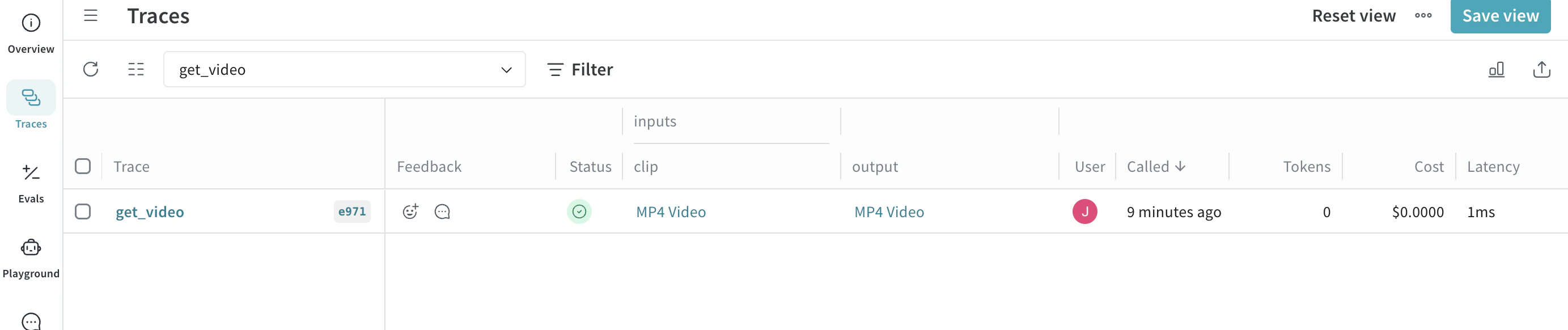
When the code sample runs successfully, you can view your video by clicking the link in the Traces table of your project.